
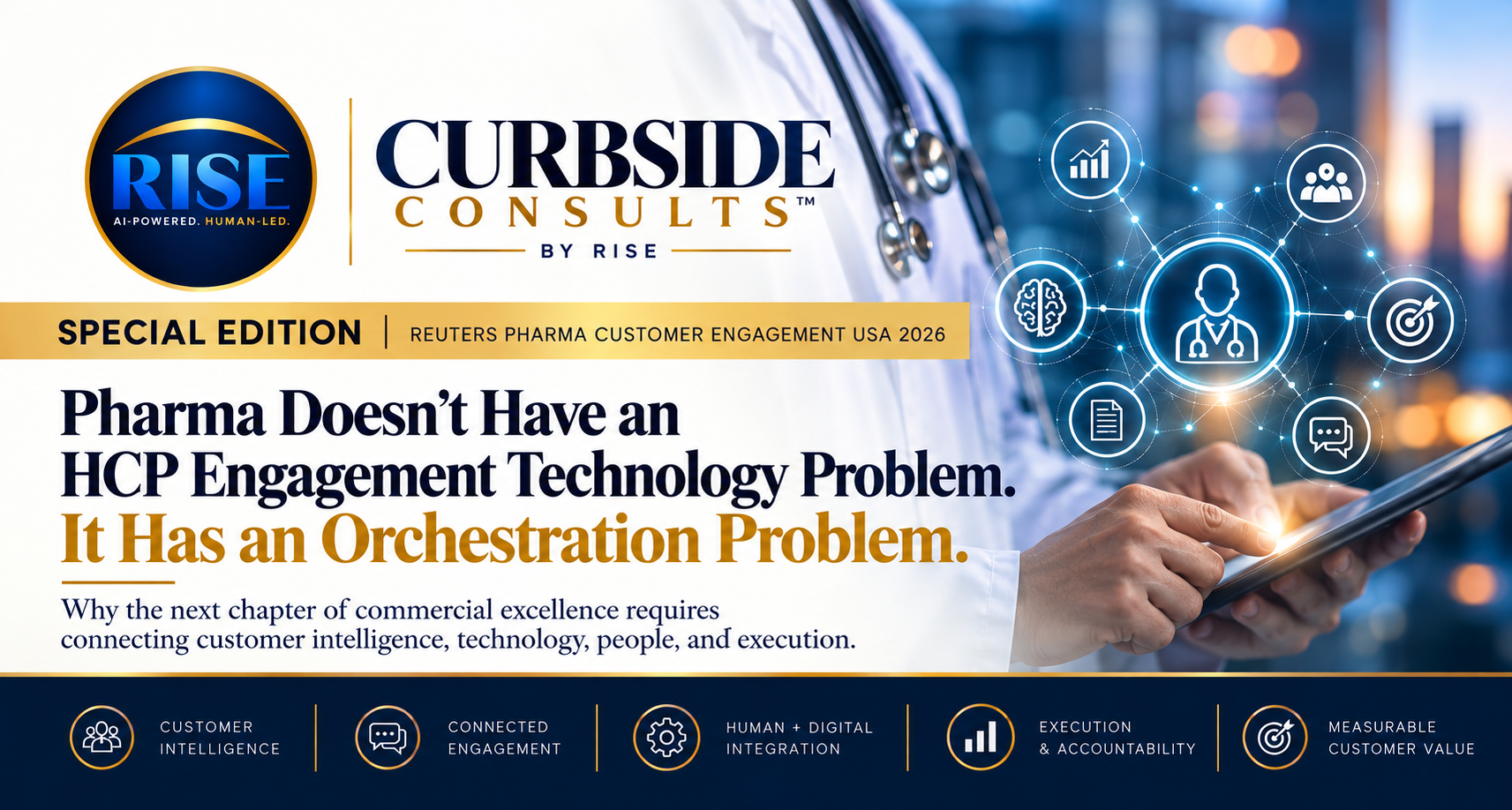
CURBSIDE CONSULTS™ SPECIAL EDITION | October 29, 2026
THE SIGNAL
I spent time this week at Reuters' Pharma Customer Engagement conference in Philadelphia.
The event brought together leaders from across pharmaceutical commercialization, medical affairs, customer experience, digital technology, data analytics, and AI, alongside solution providers helping shape the next generation of HCP engagement.
The published agenda reflected an industry undergoing significant change.
Dynamic customer orchestration.
AI-enabled personalization.
Next-best-action recommendations.
Precision HCP segmentation.
Field force transformation.
Connected customer intelligence.
Cross-functional engagement.
These are meaningful advances.
And the technology available to pharmaceutical organizations today is extraordinary compared with what existed when many of us began our commercial careers.
But as I considered the themes of the conference, one question stood out.
Are we fundamentally improving how pharmaceutical organizations engage healthcare professionals, or simply introducing more sophisticated ways to manage those interactions?
That distinction matters.
Because the next generation of commercial excellence may depend less on what technology companies deploy and more on how effectively they connect their capabilities around the customer.
WHY IT MATTERS
For decades, pharmaceutical commercial organizations have invested in improving customer engagement.
We expanded field forces.
Built sophisticated CRM environments.
Introduced digital channels.
Developed increasingly precise segmentation models.
Invested in customer analytics.
And more recently, began applying AI to personalization, content, field intelligence, and next-best-action recommendations.
Each investment has the potential to improve commercial effectiveness.
But here's the challenge.
Technology is often introduced into organizations whose operating models were designed for a different era.
Sales operates within one set of priorities.
Marketing manages another.
Medical affairs maintains distinct scientific responsibilities and compliance boundaries.
Digital teams develop new engagement capabilities.
Analytics teams generate increasingly sophisticated insights.
And individual customer-facing functions may still operate with disconnected workflows, measures, and incentives.
The result can be an organization with excellent individual capabilities but a fragmented customer experience.
More technology doesn't automatically solve that problem.
In some cases, it simply makes the fragmentation more sophisticated.
THE CURBSIDE VIEW
At RISE, we believe the next competitive advantage in pharmaceutical customer engagement will come from orchestration.
Not simply omnichannel activity.
Not simply AI-enabled personalization.
And not simply better data.
Orchestration means connecting customer understanding, organizational capabilities, technology, and execution into a coordinated system that consistently creates value.
We see five essential dimensions.
1. CUSTOMER INTELLIGENCE
Understand the healthcare professional beyond traditional targeting variables.
What are their clinical priorities?
What challenges do they face in patient care?
What information is genuinely useful?
How do their needs, preferences, and circumstances evolve?
The objective isn't simply to know more about the customer.
It's to understand how to create more relevant interactions.
2. CONNECTED ENGAGEMENT
A healthcare professional doesn't experience a pharmaceutical company as a collection of internal departments.
They experience the interactions they have with its people, content, and services.
Those interactions should be coordinated, relevant, and respectful of clinical needs and professional time.
Achieving that requires cross-functional alignment, appropriate information sharing, and clear operating boundaries.
3. HUMAN AND DIGITAL INTEGRATION
AI can help identify patterns, improve targeting, recommend actions, and support better decisions.
But meaningful engagement still depends on understanding, credibility, trust, and judgment.
The opportunity is not to replace human relationships with technology.
It's to use technology to make those relationships more valuable.
4. EXECUTION AND ACCOUNTABILITY
Who owns the customer experience?
Who coordinates engagement across functions?
How are insights translated into action?
What happens when customer needs change?
And who is responsible for improving performance?
Without clear answers, even sophisticated customer engagement strategies can become collections of disconnected initiatives.
5. MEASURABLE CUSTOMER VALUE
Traditional commercial metrics remain important.
But reach, frequency, content delivery, and channel activity don't fully describe engagement effectiveness.
Organizations should also examine whether interactions are relevant, whether customer needs are being addressed, whether workflows are improving, and whether engagement contributes to appropriate, measurable business and customer outcomes.
The goal isn't simply more engagement.
It's better engagement.
A SECOND OPPORTUNITY: THE SOLUTION PROVIDER ECOSYSTEM
There's another dimension to this transformation that deserves attention.
Pharmaceutical organizations are not developing every capability internally.
An expanding ecosystem of technology and service providers offers solutions for customer intelligence, omnichannel orchestration, AI analytics, content optimization, field effectiveness, medical engagement, and commercial execution.
The opportunity for these companies is substantial.
But so is the challenge.
A compelling technology doesn't automatically translate into a compelling enterprise buying decision.
Pharma organizations must evaluate strategic relevance, business value, integration requirements, compliance, security, implementation complexity, organizational adoption, and return on investment.
And those decisions often involve multiple stakeholders with different priorities.
At RISE, we believe solution providers need to shift from selling capabilities to helping pharmaceutical organizations solve enterprise business problems.
That requires a different approach to go-to-market strategy and business development.
Understand the customer's operating model.
Identify the business problem that matters.
Recognize the stakeholders who influence decisions.
Build executive alignment.
Demonstrate measurable value.
And establish a credible path from implementation to enterprise adoption.
This is the thinking behind RISE's Path to Yes™ and New Enterprise Buying Map™ frameworks.
Because having the right solution and successfully navigating the path to a buying decision are two different challenges.
THE MOVE
For pharmaceutical and biotechnology leaders, we'd recommend five practical actions.
1. MAP THE CURRENT CUSTOMER EXPERIENCE
Understand how HCPs experience your organization across functions, channels, and interactions.
Identify duplication, fragmentation, unnecessary friction, and unmet needs.
2. ASSESS THE COMMERCIAL OPERATING MODEL
Determine whether leadership, governance, incentives, workflows, and accountability support coordinated engagement.
3. PRIORITIZE TECHNOLOGY AGAINST BUSINESS NEEDS
Evaluate new capabilities based on the customer and commercial problems they address—not simply their technical sophistication.
4. CONNECT AI TO WORKFLOW IMPROVEMENT
Use AI where it can meaningfully improve customer intelligence, decisions, execution, and productivity within appropriate regulatory and compliance boundaries.
5. MEASURE EFFECTIVENESS, NOT JUST ACTIVITY
Develop a balanced view of customer relevance, operational effectiveness, appropriate commercial outcomes, and organizational performance.
For life sciences solution providers, the corresponding challenge is to demonstrate how your offering helps pharmaceutical organizations accomplish these objectives.
That is where product innovation becomes strategic business value.
THE CONNECTION TO ENTERPRISE AI
The themes emerging from customer engagement are closely connected to the broader enterprise AI transformation challenge.
AI adoption is accelerating.
But deploying AI capabilities and creating measurable organizational impact are not the same thing.
That's why RISE is conducting The RISE Index™ 2027.
We're examining the organizational conditions influencing AI readiness, adoption, operational integration, and measurable business impact across life sciences.
The research is designed to help us better understand how leadership, governance, workforce readiness, technology capabilities, and execution influence transformation.
Over time, we intend to connect these findings with credible industry research and our proprietary RISE frameworks to help organizations develop more practical AI strategies.
The research is underway, and its findings remain to be established.
But the question is already clear.
How do organizations move from technology investment to sustained enterprise performance?
Customer engagement is one important place to begin.
ONE QUESTION TO TAKE WITH YOU
If your organization added no new customer engagement technology next year, how much could performance improve simply by better connecting the capabilities you already have?
That may be one of the most valuable questions commercial leaders can ask.
HELP SHAPE THE RISE INDEX™ 2027
We're inviting life sciences leaders across commercial, medical, digital, technology, and enterprise functions to contribute their perspectives to our research.
The survey takes approximately 8–10 minutes.
Participate in The RISE Index™ 2027:
https://therisegroup.ai/research/enterprise-ai-adoption-2027
Your perspective can help build a more practical understanding of AI transformation in life sciences.
SOURCES & FURTHER READING
Reuters Events — Pharma Customer Engagement USA 2026, Official Agenda
https://events.reutersevents.com/pharma/customer-engagement-usa/agenda
Reuters Events — Pharma Customer Engagement USA 2026, Speaker Lineup
https://events.reutersevents.com/pharma/customer-engagement-usa/speakers/1000
RISE | GTM Strategy. Strategic Business Development. Commercial Excellence. AI Transformation.
AI Powered. Human Led.
Continue the conversation
Get the next Curbside Consult